
Moving Average Indicator
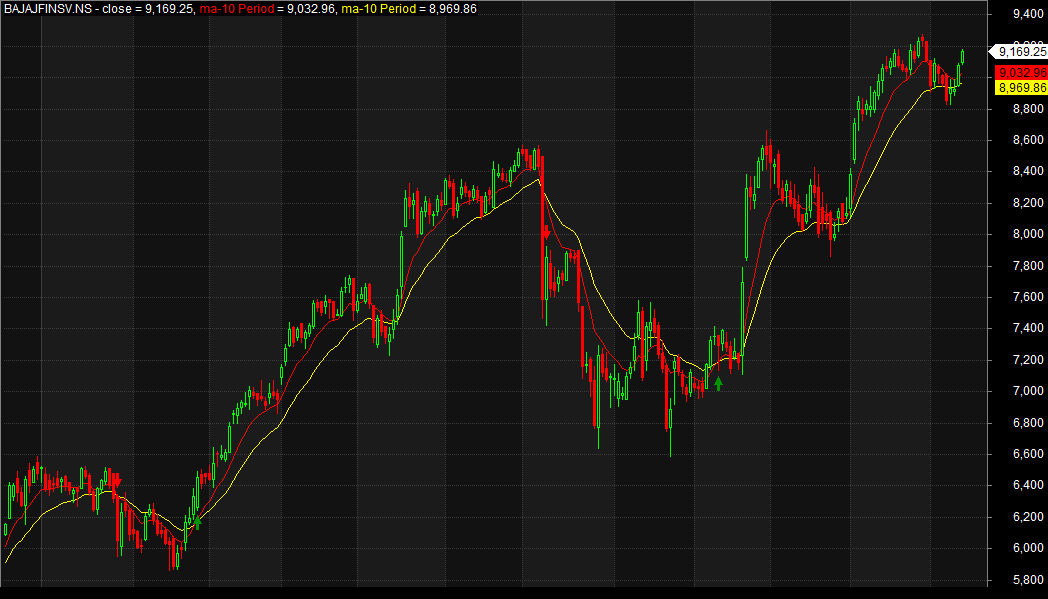
A moving average is a widely used technical analysis indicator that helps smooth out price action by filtering out noise from random short-term price fluctuations. It is a trend-following, or lagging, indicator because it is based on past prices. The average is taken over a specified number of periods, usually a number of days or weeks, and is plotted on top of a price chart. There are several types of moving averages, including the simple moving average (SMA), the exponential moving average (EMA), and the linear weighted moving average (LWMA).
The SMA is calculated by taking the sum of the closing prices of a security over a specified number of periods, and then dividing that sum by the number of periods. For example, if you wanted to calculate a 50-day SMA, you would add up the closing prices of a security over the past 50 days and then divide that sum by 50. The resulting average is plotted on the chart, and a new average is calculated each day by dropping the oldest price and adding the most recent price.
The EMA gives more weight to recent prices, which makes it more sensitive to recent price changes than the SMA. The EMA is calculated using a formula that places a greater weight on the most recent prices.
The LWMA is similar to the SMA, but it gives more weight to the most recent prices, making it more responsive to recent price changes.
Moving averages can be used to identify trends, spot trend changes, and provide trade signals. They can also be used to smooth out price action and filter out noise.
Types of Moving Average Indicator
There are several types of moving average indicators, including:
Simple Moving Average (SMA): This is the most basic type of moving average. It is calculated by taking the sum of the closing prices of a security over a specified number of periods, and then dividing that sum by the number of periods.
Exponential Moving Average (EMA): This type of moving average gives more weight to recent prices, which makes it more sensitive to recent price changes than the SMA. It is calculated using a formula that places a greater weight on the most recent prices.
Linear Weighted Moving Average (LWMA): This moving average is similar to the SMA, but it gives more weight to the most recent prices, making it more responsive to recent price changes.
Hull Moving Average (HMA): This is a fast-moving average that is designed to reduce the lag associated with traditional moving averages. It is calculated using a weighted moving average and an exponential moving average.
Adaptive Moving Average (AMA): This type of moving average is designed to adapt to changing market conditions by using a volatility-based formula to adjust the weighting of the average.
Triangular Moving Average (TMA): This moving average is calculated by first taking the average of a security's prices over a specified number of periods, and then taking the average of that average over a longer number of periods.
Variable Moving Average (VMA): This moving average allows the user to specify the weighting given to each period, rather than using a fixed formula like the other types of moving averages. This allows the user to customize the average to their own preferences.